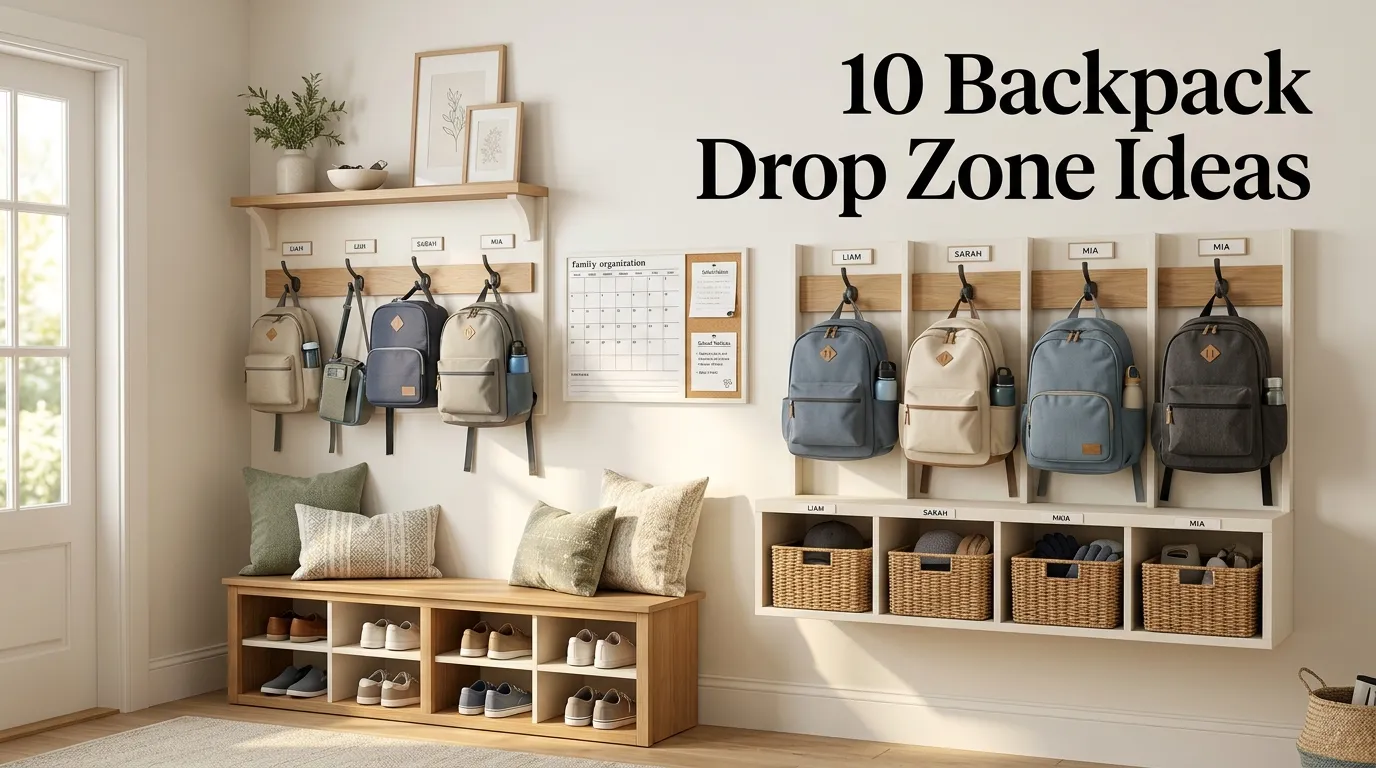
10 Backpack Drop Zone Ideas
The area where backpacks land at the end of the school day can easily become one of the messiest spots in a home. A bag gets dropped by the door, shoes end up underneath it, lunch containers stay tucked inside, and jackets somehow migrate onto the nearest chair. Before long, the entryway feels cluttered before anyone has even had time to clean it.
A dedicated backpack drop zone gives all those everyday items a logical home. More importantly, it makes the routine easier for kids and adults because they don’t have to decide where things belong every afternoon.
The best drop zones don’t have to be large. A small wall near the garage entry, a corner of a mudroom, or a narrow section of an apartment hallway can become a functional landing spot with a few hooks, baskets, shelves, and labels.
If you’re anything like me, the most successful organization systems are the ones that require almost no effort to maintain. That’s why a backpack drop zone works best when bags can be hung quickly, shoes have a nearby place to go, and homework or lunch items have their own designated spots.
You can also make the space attractive enough to feel like part of your home’s decor. Natural wood, woven baskets, simple hooks, neutral colors, and framed labels can turn a practical school station into an organized extension of your entryway.
These 10 backpack drop zone ideas range from simple wall-mounted solutions to more complete mudroom-style stations. Whether you’re organizing one child’s belongings or creating a shared family system, the goal is the same: make coming home and leaving again easier.
Table of Contents
1. Wall Hook Station
Create a simple vertical storage area where backpacks can be hung immediately after school.
2. Entryway Bench
Combine backpack hooks with a bench to create a convenient place for shoes and daily items.
3. Individual Cubbies
Give each child a dedicated cubby for backpacks, shoes, jackets, and school supplies.
4. Narrow Hallway Station
Use vertical wall space to create a drop zone even when floor space is limited.
5. Mudroom Backpack Wall
Build a complete family organization station with hooks, shelves, baskets, and seating.
6. Basket Storage
Use labeled baskets to collect smaller school items and accessories.
7. Locker Style Storage
Create a structured look with individual compartments inspired by traditional school lockers.
8. Pegboard Drop Zone
Use a flexible pegboard system to customize hooks, shelves, and accessories.
9. Minimalist Drop Zone
Keep the setup visually clean with only the essential storage pieces.
10. Homework Ready Station
Design the drop zone so backpacks, papers, supplies, and homework naturally flow into the next step.
1. Wall Hook Station
Quick Benefits
- Uses very little floor space
- Makes backpacks easy to grab
- Works in small entryways
- Keeps bags off the floor
- Creates an easy daily routine
Why It Works
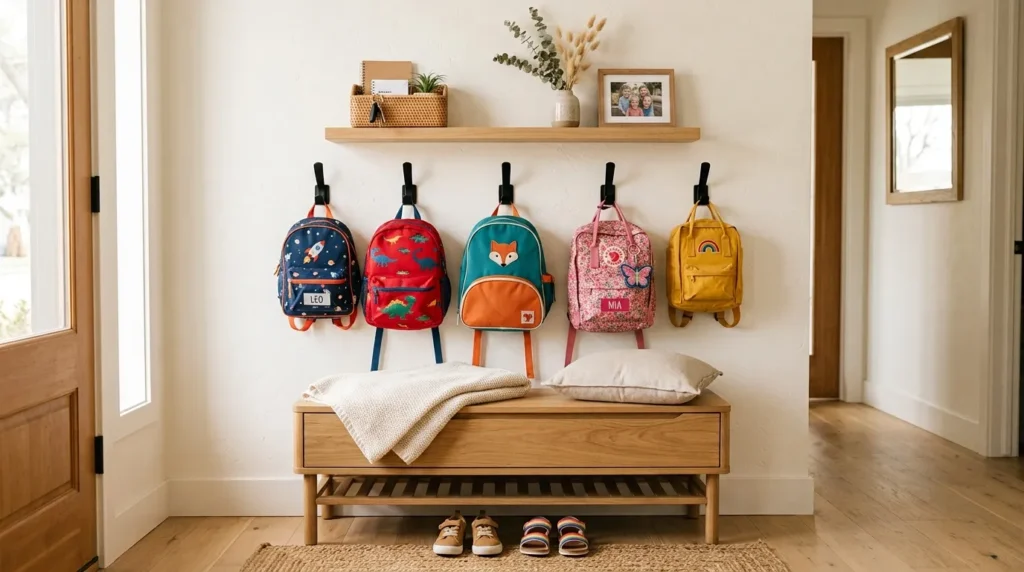
Sometimes the simplest organization system is the one that works best. A row of sturdy wall hooks gives backpacks an obvious home without requiring a large cabinet or complicated storage system.
This is particularly useful for families who have a narrow entryway or don’t have a dedicated mudroom. The wall itself becomes the storage space, leaving valuable floor area available for shoes and everyday movement.
The key is installing hooks at a comfortable height for the people using them. If children are expected to put away their own backpacks, the hooks need to be reachable without assistance.
A small shelf above the hooks can provide additional space for hats, small baskets, or decorative items.
How To Style It
Choose hooks that can support the weight of a fully loaded backpack. Follow the manufacturer’s installation instructions and use appropriate wall anchors for your wall type.
Mount several hooks in a straight row or arrange them vertically if wall width is limited.
Add a narrow shelf above the hooks for small baskets or seasonal accessories. A simple framed sign can make the area feel intentional without adding much clutter.
For a warm entryway, combine natural wood with black, brass, or simple metal hooks. Neutral baskets and a small plant can soften the look.
Keep the area immediately beneath the hooks relatively clear so bags can be removed without bumping into furniture.
2. Entryway Bench
Quick Benefits
- Combines seating and storage
- Creates a comfortable landing area
- Gives shoes a designated location
- Works well in family entryways
- Adds furniture-style appeal
Why It Works
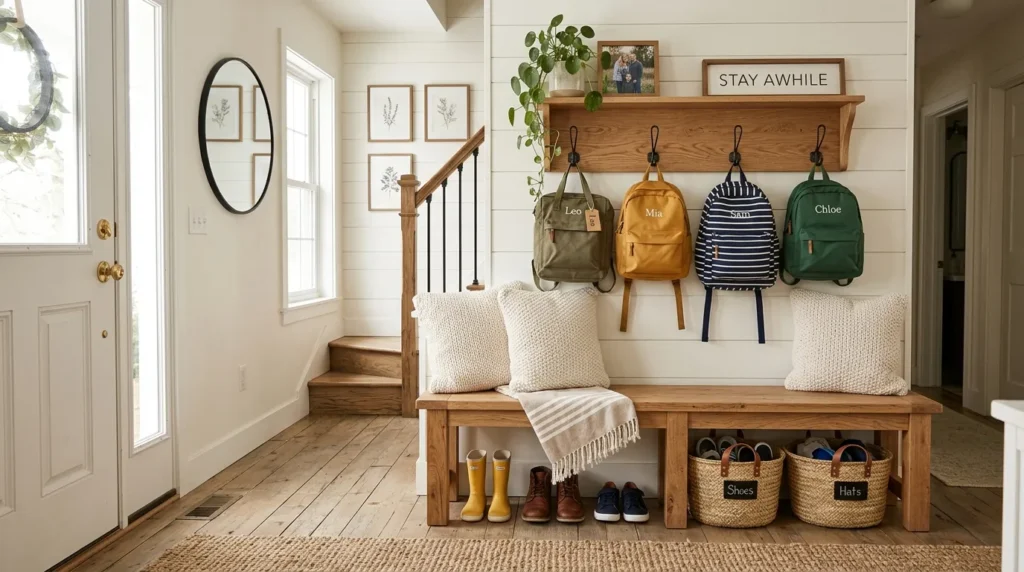
An entryway bench can turn a simple backpack drop zone into a complete transition area. Children can sit down to remove shoes while hanging their backpack directly above the bench.
The combination of hooks and seating is particularly useful because it addresses several common entryway problems at once.
A bench with an open shelf underneath can hold shoes, while baskets can contain hats, gloves, or smaller accessories.
This setup can also look more like traditional home furniture than a purely functional storage unit, which makes it attractive for homes where the entryway is visible from the main living space.
How To Style It
Choose a bench that fits the available wall width without blocking the walkway.
Install sturdy hooks above it and leave enough vertical space for backpacks to hang comfortably without resting on the bench.
Place shoes underneath the bench in a low basket or directly on a washable mat.
Add a few neutral cushions if the bench is large enough for comfortable seating. Keep decorative pillows minimal if children will use the space every day.
A combination of wood, woven baskets, and neutral textiles creates a warm family-friendly aesthetic.
3. Individual Cubbies
Quick Benefits
- Gives every child a defined space
- Keeps belongings separated
- Makes daily organization easier
- Handles multiple school items
- Creates visual order
Why It Works
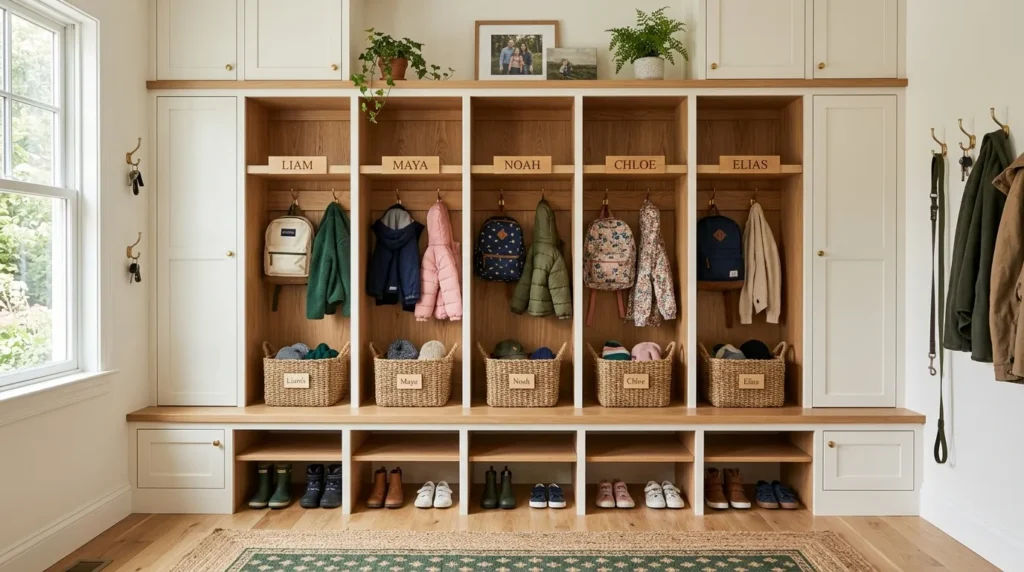
Shared storage can quickly become confusing when several children are coming home with backpacks, jackets, shoes, lunch bags, and school papers. Individual cubbies eliminate much of that confusion by giving each person a clearly defined area.
A cubby system also teaches a simple organizational principle: your belongings have a home.
For younger children, labels or names can make the system easier to follow. Older children may prefer simple numbers, initials, or color coding.
The cubby doesn’t need to hold everything. Its purpose is to create a central landing point where the most frequently used items can be placed.
How To Style It
Choose a cubby unit with compartments large enough to accommodate the backpacks your family actually uses.
Add a sturdy hook inside or above each cubby for jackets or additional bags.
Use matching baskets for smaller items so the overall unit looks cohesive.
For a more polished look, choose cubbies in natural wood, white, or another finish that complements your entryway.
If the cubbies are positioned in a busy hallway, secure the furniture properly according to the manufacturer’s instructions so it remains stable.
4. Narrow Hallway Station
Quick Benefits
- Works in small spaces
- Uses vertical storage
- Keeps walkways clear
- Fits apartment entryways
- Creates a defined drop zone
Why It Works
Not every home has room for a mudroom or large entryway bench. A narrow hallway can still accommodate a backpack station if you use the wall efficiently.
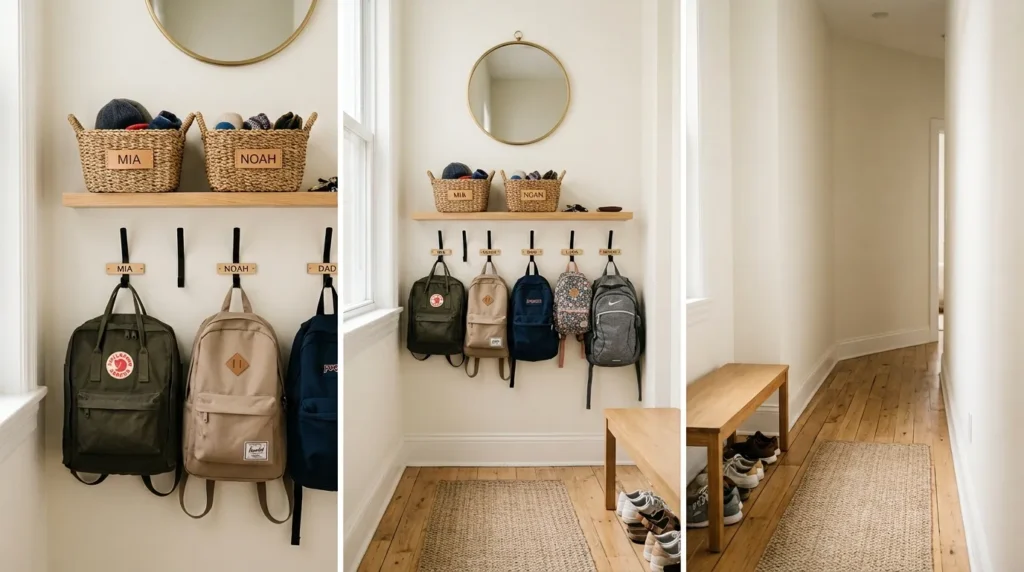
A slim shelf, a few hooks, and one or two narrow baskets can provide surprisingly effective storage without taking up much floor space.
The trick is to keep the furniture shallow and the wall storage vertical. This allows backpacks to hang flat against the wall instead of creating obstacles along the walkway.
For apartments or smaller homes, this can be one of the most practical solutions.
How To Style It
Measure the hallway carefully before buying furniture. Leave enough clear walking space for people to move comfortably.
Choose a narrow wall shelf with hooks underneath or install the components separately.
Use small labeled baskets for keys, hair accessories, lunch notes, or other items that need a home.
A washable runner can define the entry area while protecting the floor from wet shoes.
Keep wall decor minimal so the station remains functional and doesn’t feel visually crowded.
5. Mudroom Backpack Wall
Quick Benefits
- Creates a complete family station
- Combines several storage functions
- Handles backpacks and outerwear
- Provides room for shoes
- Makes busy mornings easier
Why It Works
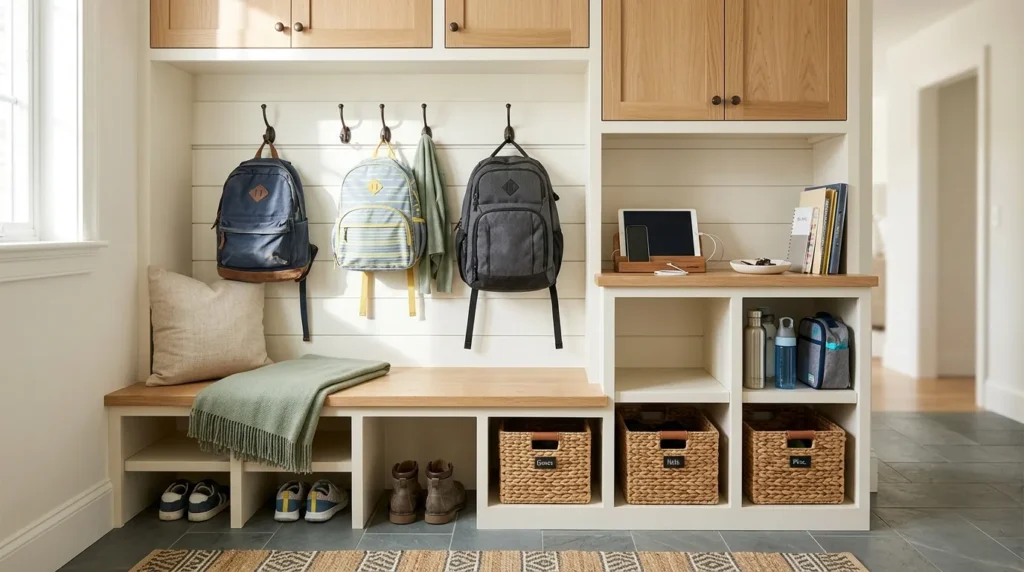
If you have a mudroom or generous entryway, you can create a dedicated backpack wall that functions as a miniature command center.
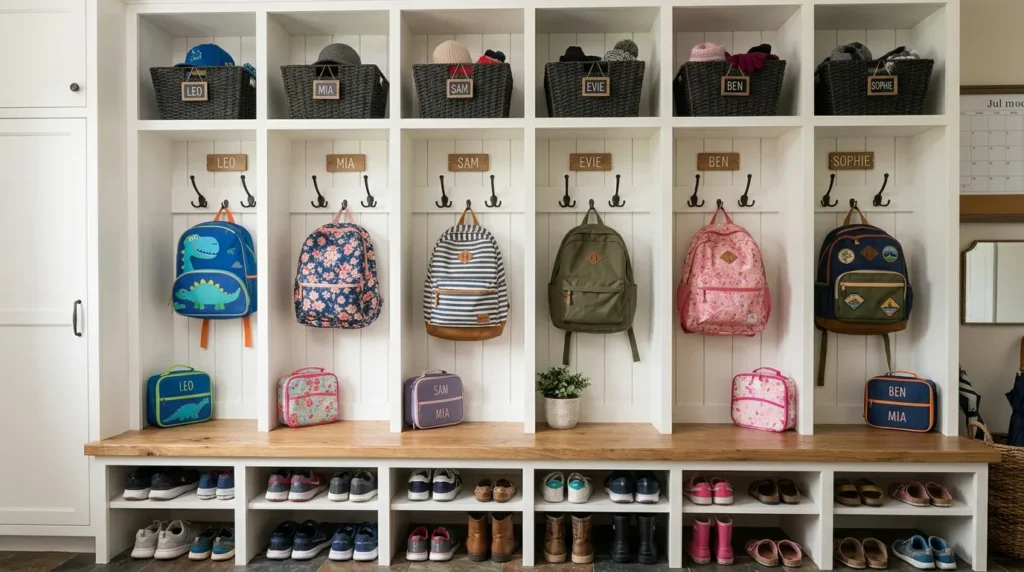
A combination of hooks, cubbies, shelves, baskets, and seating gives every frequently used item a logical location.
This type of system is particularly useful for families with several children because each person can have a defined section.
The most effective layouts place frequently used items between waist and shoulder height while using upper shelves for less frequently accessed belongings.
How To Style It
Start by dividing the wall into individual zones.
Each zone might include:
- One or two backpack hooks
- A small shelf
- A basket
- Space for shoes
- A hook for jackets
Use matching materials across the entire wall to make the storage feel intentional.
Natural wood benches paired with white cabinetry can create a classic mudroom appearance. Black hooks and woven baskets can add contrast without making the area feel overly busy.
Include a durable floor mat or washable runner to protect the entryway.
6. Basket Storage
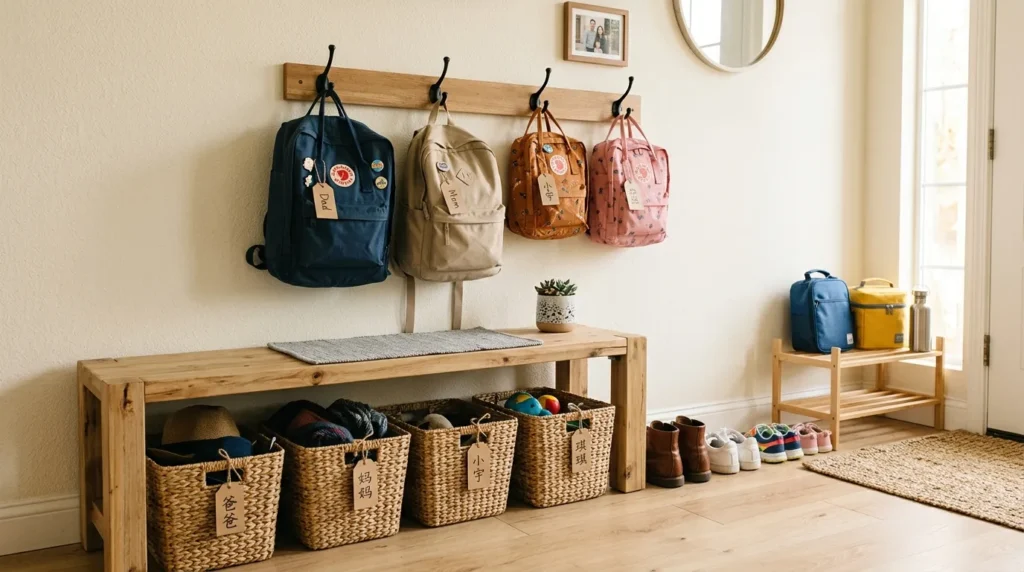
Quick Benefits
- Hides visual clutter
- Adds flexible storage
- Works with existing furniture
- Easy to label
- Adds texture to the entryway
Why It Works
Backpacks are only part of the school-day clutter. Lunch bags, water bottles, hats, sports accessories, and small personal items also need somewhere to go.
Baskets are useful because they provide containment without requiring every item to be perfectly arranged.
A labeled basket for each child can become a flexible catch-all for items that don’t fit naturally into a backpack hook or cubby.
The goal isn’t to use baskets for everything. Too many baskets can simply hide clutter rather than solve it. Use them for categories that genuinely benefit from flexible storage.
How To Style It
Choose baskets that fit beneath a bench, inside cubbies, or on a shelf.
Natural woven baskets work beautifully in warm neutral interiors. Fabric bins can provide a softer look, while structured baskets can create a cleaner appearance.
Add simple labels using names, initials, or categories.
Keep frequently used baskets at an accessible height. Reserve higher shelves for items that children don’t need to access independently.
7. Locker Style Storage
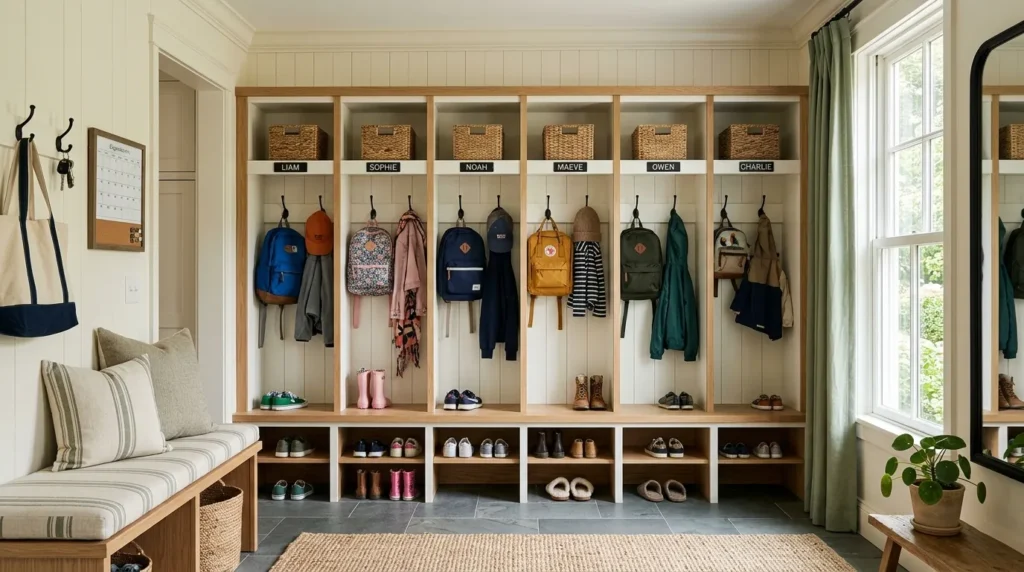
Quick Benefits
- Creates individual zones
- Offers a structured appearance
- Works well for multiple children
- Adds vertical storage
- Makes items easy to separate
Why It Works
Locker-inspired storage combines the personal feel of a school locker with the warmth of home organization.
Each section can hold a backpack, jacket, shoes, and smaller belongings. This makes it especially helpful for families who want a defined system without creating a completely custom built-in.
The individual compartments also reduce the chances of one person’s belongings spreading into another person’s space.
A locker-style unit can work in a mudroom, garage entry, basement entrance, or larger hallway.
How To Style It
Choose a unit with ventilation and durable materials if it will regularly hold wet shoes or jackets.
Add a hook inside each compartment and a shelf or cubby for smaller belongings.
For a residential feel, choose finishes such as painted wood, natural oak, or a soft neutral color rather than industrial metal.
Add woven baskets or simple labels to personalize each section.
Keep the top of the unit relatively uncluttered. A few decorative objects are fine, but the storage area should remain practical.
8. Pegboard Drop Zone
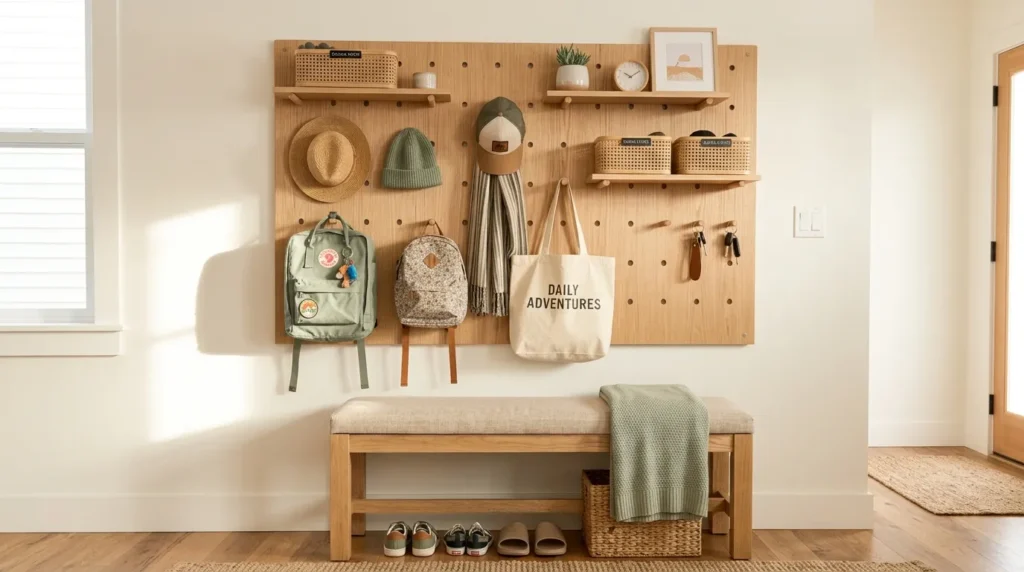
Quick Benefits
- Highly customizable
- Uses vertical space
- Easy to change over time
- Supports hooks and shelves
- Works for changing family needs
Why It Works
A pegboard gives you flexibility that fixed hooks don’t. You can move hooks, add shelves, attach baskets, and adjust the layout as children grow.
This makes it particularly useful for families whose storage needs change from year to year.
A younger child may need a low backpack hook and small basket, while an older student may need more space for technology accessories, sports equipment, or school projects.
The pegboard also adds visual interest without requiring a large piece of furniture.
How To Style It
Choose a pegboard finish that complements the surrounding entryway.
Install sturdy hooks at accessible heights and use small shelves for lightweight items.
Add a basket for papers or small accessories.
Keep the arrangement symmetrical if you prefer a clean look, or use varied hook heights for a more casual utility-wall appearance.
Don’t overload the board. The goal is flexible organization, not turning the wall into a storage pile.
9. Minimalist Drop Zone
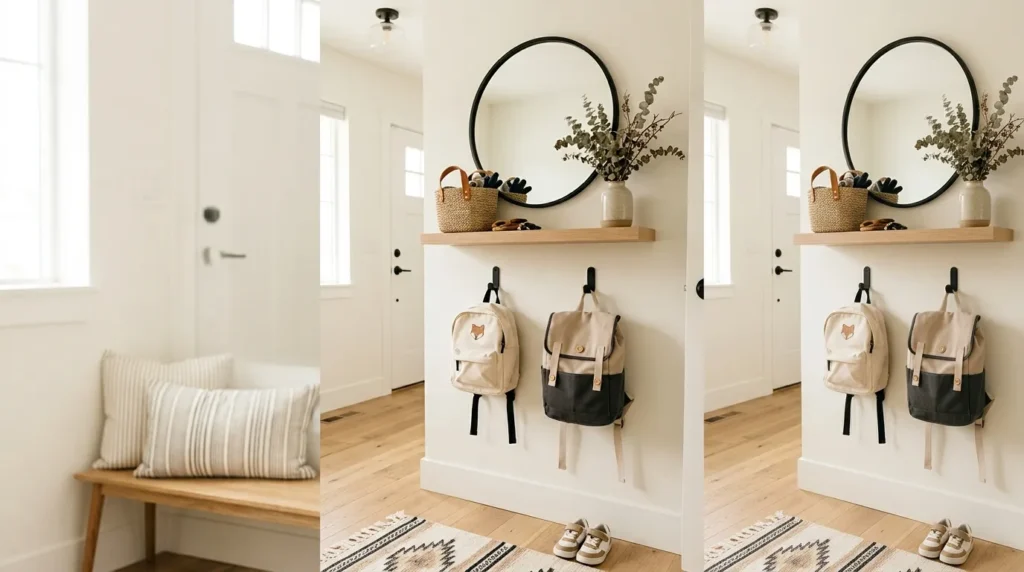
Quick Benefits
- Keeps the entryway visually calm
- Requires fewer storage pieces
- Easy to maintain
- Works in small homes
- Fits modern interiors
Why It Works
A backpack drop zone doesn’t have to contain multiple shelves, baskets, and cabinets. For some households, two or three well-placed hooks are enough.
Minimalist organization works particularly well when the entryway is small or visible from the living room.
The key is limiting what belongs in the area. Backpacks get hooks, shoes get a designated mat or shelf, and everything else has a separate home.
This approach reduces the temptation to let the drop zone become a permanent storage area for random belongings.
How To Style It
Install a simple row of quality hooks against a clean wall.
Add one slim shelf above if additional storage is needed.
Use one small basket rather than several containers.
Keep the palette restrained with white, beige, light wood, black, or another color that matches your home’s existing decor.
A framed piece of artwork or a small mirror can make the area feel finished without interfering with the organization.
10. Homework Ready Station
Quick Benefits
- Connects backpack storage to homework
- Keeps school papers accessible
- Creates a natural after-school routine
- Reduces misplaced assignments
- Supports independent organization
Why It Works
One of the smartest backpack drop zones is designed around what happens immediately after a child gets home.
Instead of simply hanging the backpack and forgetting about it, create a system that encourages the next step: remove lunch items, take out homework, check papers, and prepare supplies.
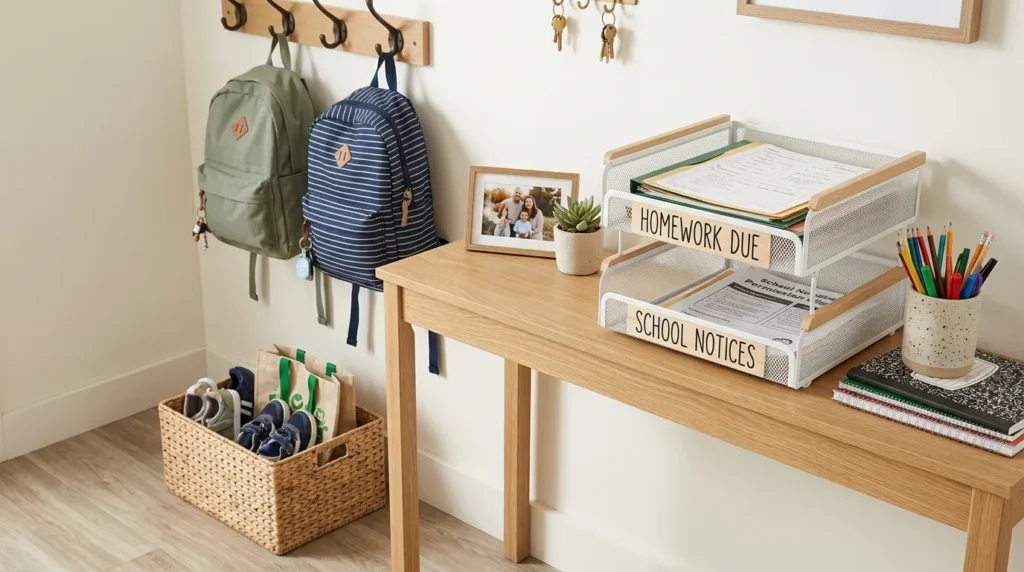
A small nearby desk, wall file, or paper tray can make this transition much easier.
The idea is not to turn the entryway into a full classroom. It is simply about creating a clear path from “arriving home” to “ready for tomorrow.”
How To Style It
Place a wall-mounted file organizer or a few labeled trays near the backpack hooks.
Use categories such as:
- Homework
- Parent forms
- School notices
- To return
A small shelf can hold pencils, sticky notes, or other frequently used supplies.
If space permits, add a compact desk or console table nearby.
Keep the surface mostly clear so it remains a functional landing area rather than another clutter zone.
Frequently Asked Questions
Where should backpacks go when you get home?
A dedicated hook, cubby, or backpack station near the home’s main entrance is usually the most practical option. Keeping backpacks off the floor reduces clutter and makes them easier to find the next morning. The best location is somewhere children naturally pass through when arriving home, such as a mudroom, garage entry, hallway, or foyer.
How do you create a backpack drop zone in a small space?
Use vertical wall space instead of adding bulky furniture. A few sturdy hooks, a narrow shelf, and one small basket can create an effective drop zone. If the hallway is particularly narrow, choose shallow storage and keep the floor clear so the area remains easy to walk through.
What should go in a backpack drop zone?
The station can hold backpacks, jackets, shoes, lunch bags, water bottles, school papers, and small accessories. Keep the system focused on items used during the school-day transition. Less frequently used belongings can stay in another storage area so the drop zone doesn’t become overloaded.
How do you keep a backpack station organized?
Give each child or category a designated space and make putting items away part of the arrival routine. Remove trash and old papers regularly, return lunch containers to the kitchen, and use labeled baskets for small accessories. A quick weekly reset can prevent the station from becoming cluttered.
How high should backpack hooks be?
Hooks should be installed at a comfortable height for the people using them. Children’s hooks should be low enough for them to reach independently, while adult hooks can be positioned higher. Always install hooks according to the manufacturer’s weight and mounting instructions.
What is the best furniture for a backpack drop zone?
The best furniture depends on your space. An entryway bench with hooks works well for families who need seating and shoe storage. Cubbies are useful for multiple children, while narrow shelves and hooks work well in small hallways. A mudroom-style unit provides the most comprehensive storage.
How can I make a backpack station look stylish?
Choose storage that complements your home’s existing decor. Natural wood, neutral baskets, simple metal hooks, soft textiles, and minimal labels can make a practical station feel intentional. The key is to limit visual clutter and repeat a few materials or colors throughout the area.
Conclusion
A backpack drop zone can solve a surprisingly common household problem: the pile of school bags, shoes, jackets, lunch containers, and papers that appears near the door every afternoon.
The best solution doesn’t have to be expensive or complicated. A few sturdy hooks may be enough for one family, while another household may benefit from a full mudroom wall with cubbies, baskets, seating, and individual storage zones.
The important part is creating a system that matches the way your family actually enters and leaves the house.
Place backpacks where children naturally walk after school. Give shoes a nearby home. Keep paperwork contained. Add baskets only when they serve a specific purpose. Most importantly, make the system easy enough that everyone can use it without constant reminders.
If you’re working with a small entryway, start with vertical storage. If you have more room, build a complete station around a bench or cubby system. And if you want the space to blend beautifully with your home, choose materials and colors that already appear elsewhere in your decor.
A well-designed backpack drop zone isn’t just about making the entryway look tidy. It creates a smoother transition between school and home, helping everyone know where things go and making tomorrow morning a little easier.
Related Articles
- 10 Back to School Organization Ideas for a Smooth School Year
- 15 Mudroom Organization Ideas for Busy Families
- 10 Small Entryway Organization Ideas
- How to Organize a Family Command Center
- 12 Entryway Storage Ideas for a Clutter-Free Home