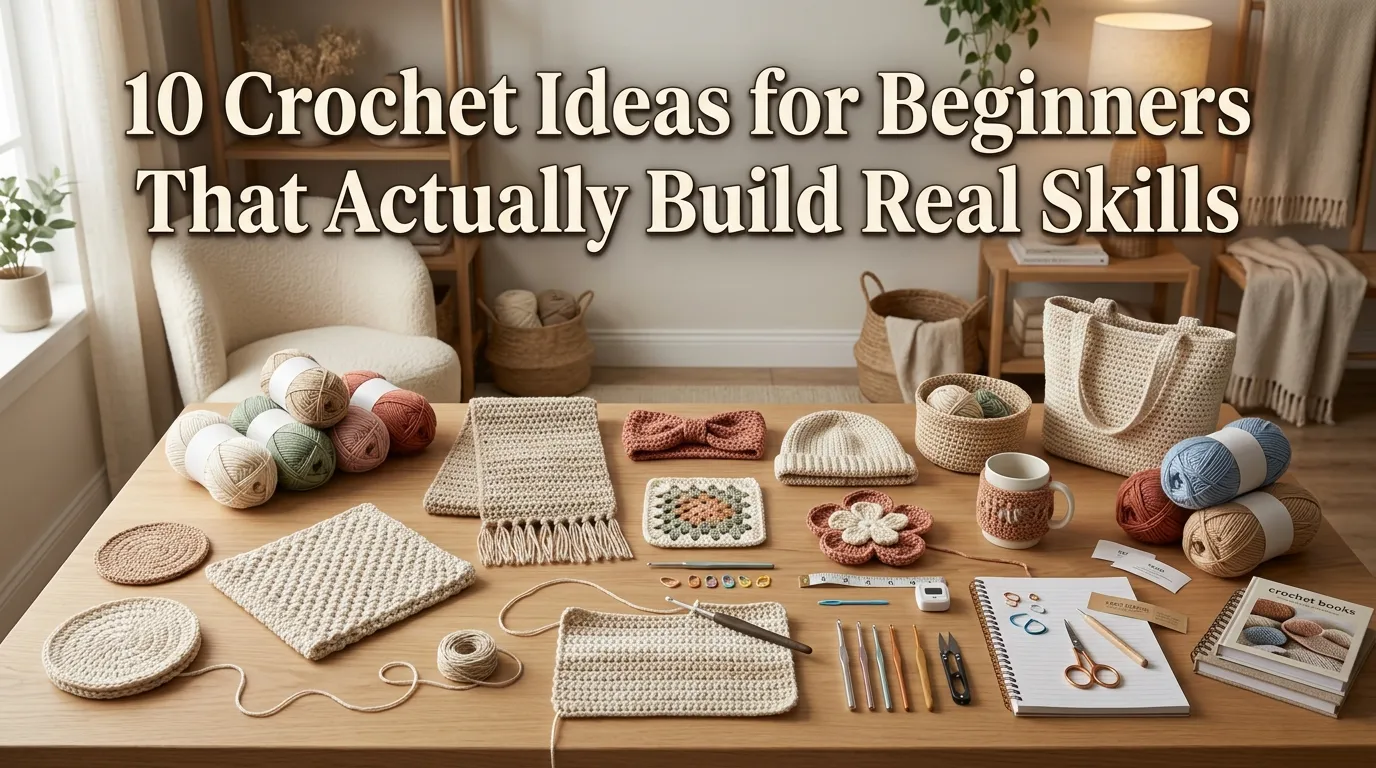
10 Crochet Ideas for Beginners That Actually Build Real Skills
Starting to crochet can feel a little overwhelming the moment you open Pinterest and see intricate blankets, sweaters, and amigurumi animals that look nothing like anything you could make with a hook and a ball of yarn. In my experience, the biggest mistake new crocheters make isn’t picking the wrong yarn or the wrong hook — it’s picking a first project that’s far too ambitious, getting frustrated, and setting the whole hobby aside before the basics ever really click.
If you’re anything like me, you probably want to see real, finished, usable projects rather than another swatch of single crochet stitched into a square that just gets tossed in a drawer. The good news is that some of the most useful, giftable crochet projects out there are also genuinely beginner-friendly, built from just one or two stitches repeated with enough consistency to actually finish something you’ll be proud of.
A mistake many new crocheters make is trying to learn several stitches at once before starting a real project. That’s why many experienced crocheters recommend picking a single stitch — usually single crochet or half double crochet — and building an entire first project around it, rather than jumping into a pattern that requires switching techniques every few rows.
I’ve noticed that the beginner crochet projects people save most often on Pinterest share a few things in common: a simple, repetitive stitch pattern, forgiving yarn that hides small mistakes, and a finished size small enough to complete in a few sittings rather than dragging on for months.
In this guide, I’m walking through ten crochet ideas for beginners that build real, transferable skills — from your very first practice swatch to projects you can genuinely use or gift once they’re finished. Each idea includes practical guidance on stitches, yarn, and technique so you know exactly what you’re working toward.
Table of Contents
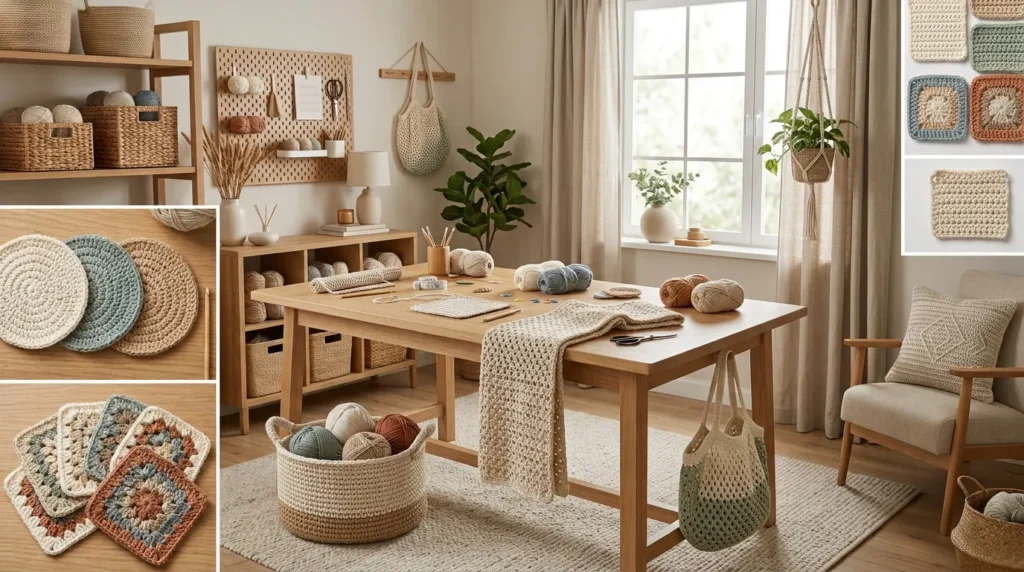
- Basic Practice Swatch A foundational first project to learn tension and stitch consistency.
- Single Crochet Dish Cloth A simple, useful project built entirely on one stitch.
- Chunky Knit-Look Scarf A quick, satisfying project using thick yarn and a large hook.
- Granny Square Coaster Set An introduction to the classic granny square technique.
- Half Double Crochet Beanie A wearable project that builds confidence with shaping.
- Amigurumi Starter Plushie A first introduction to working in the round.
- Simple Market Tote Bag A practical project combining stitch consistency and structure.
- Chunky Crochet Blanket A large but beginner-friendly project using basic repetition.
- Crochet Headband A quick accessory project perfect for practicing edges.
- Basic Baby Blanket A meaningful, giftable project built on repeated simple rows.
1. Basic Practice Swatch
Quick Benefits
- Builds foundational tension control
- Requires no pattern reading
- Uses minimal yarn
- Helps identify hook size preference
- Low-pressure starting point
Why It Works
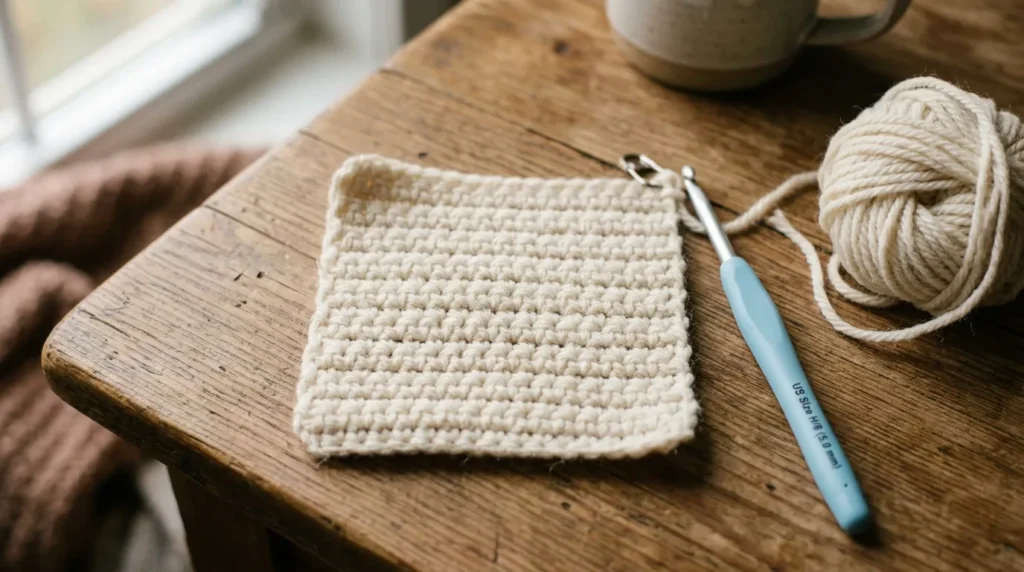
Before starting any real project, a basic practice swatch teaches the single most important skill in crochet: consistent tension. In my experience, this is the step most beginners want to skip, eager to jump straight into a finished object, but skipping it usually means unpicking rows later once tension issues become obvious in a real project. A swatch removes the pressure of “getting it right” since there’s no finished product riding on it — it’s simply a space to get comfortable holding the hook and yarn together.
How To Get Started
Chain about 20 stitches using a worsted weight yarn and a 5.0mm (H) hook, both beginner-friendly choices that are easy to see and work with. Work single crochet stitches back and forth for 15–20 rows, focusing on keeping each stitch roughly the same size and tightness as the one before it. One simple trick I always suggest is counting stitches at the end of every row while you’re still learning — if the count changes row to row, that’s usually a sign stitches are being missed or added accidentally, and it’s much easier to fix that habit on a swatch than on a real project.
2. Single Crochet Dish Cloth
Quick Benefits
- First real, usable finished project
- Uses only one stitch throughout
- Inexpensive with cotton yarn
- Quick to complete in one or two sittings
- Great for practicing straight edges
Why It Works
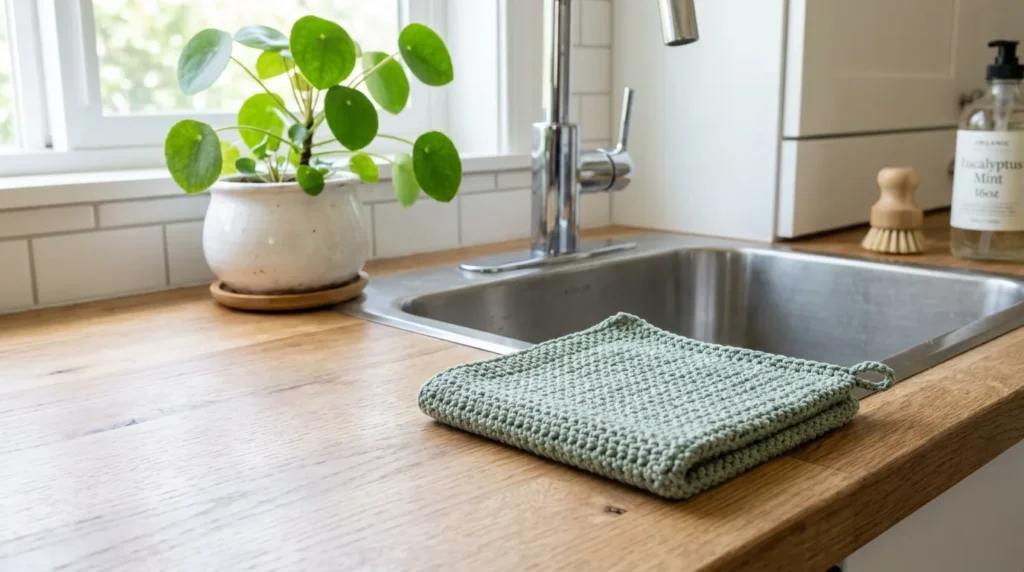
A single crochet dish cloth is one of the most commonly recommended first projects because it takes the practice swatch concept and turns it into something genuinely useful, without introducing any new techniques. That’s why many experienced crocheters recommend this as the very first “real” project — it builds confidence by producing a finished, usable item while the only skill required is the single crochet stitch already practiced on a swatch. I’ve seen this project help beginners transition from “practicing” to actually finishing something in a single afternoon.
How To Get Started
Using worsted weight cotton yarn and a 5.0mm hook, chain 25 stitches and work single crochet across each row until the piece is roughly square. Cotton yarn is worth the small extra cost here since it holds its shape well and is machine washable, making the finished cloth genuinely functional rather than just a practice piece. Weave in the loose ends once finished using a yarn needle, tucking them through several stitches on the back side of the work so they stay secure through repeated washing.
3. Chunky Knit-Look Scarf
Quick Benefits
- Fast, satisfying project with visible progress
- Uses thick yarn that hides small mistakes
- Minimal stitch count per row
- Great confidence-building second project
- Makes an easy, thoughtful gift
Why It Works
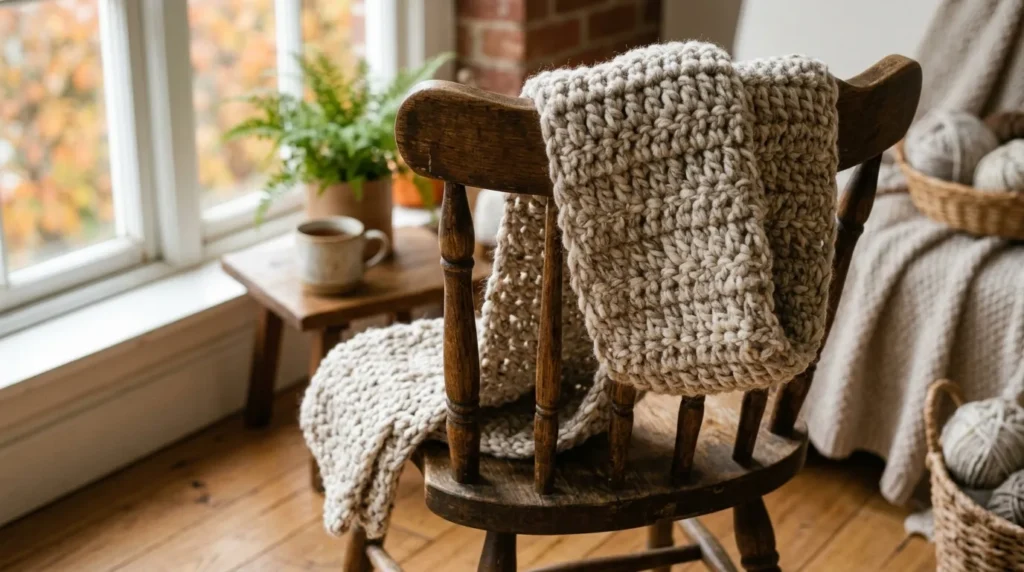
A chunky scarf made with thick yarn and a large hook is one of the most satisfying early projects because the size of the yarn does a lot of the visual work — rows build up quickly, and small tension inconsistencies are much less noticeable than they would be with thinner yarn. One thing that works especially well about this project is the sense of momentum it builds; because each row adds noticeable length, beginners tend to stay motivated through to the finish in a way that’s harder with slower, more detailed projects.
How To Get Started
Choose a bulky or super bulky weight yarn paired with a 9.0mm (M/N) hook, and chain around 12–15 stitches for a standard scarf width. Work half double crochet across each row, continuing until the scarf reaches your desired length, typically 60–70 inches for a scarf that can be looped or wrapped. Because the yarn is thick, this project moves noticeably faster than a dish cloth or swatch, making it a good confidence boost after finishing a first, smaller project. A mistake many beginners make with chunky yarn is using too small a hook, which makes stitches difficult to see and work into — always check the yarn label’s recommended hook size as a starting point.
4. Granny Square Coaster Set
Quick Benefits
- Introduces the classic granny square technique
- Small, quick to complete
- Great way to practice color changes
- Scalable into larger projects later
- Uses minimal yarn per piece
Why It Works
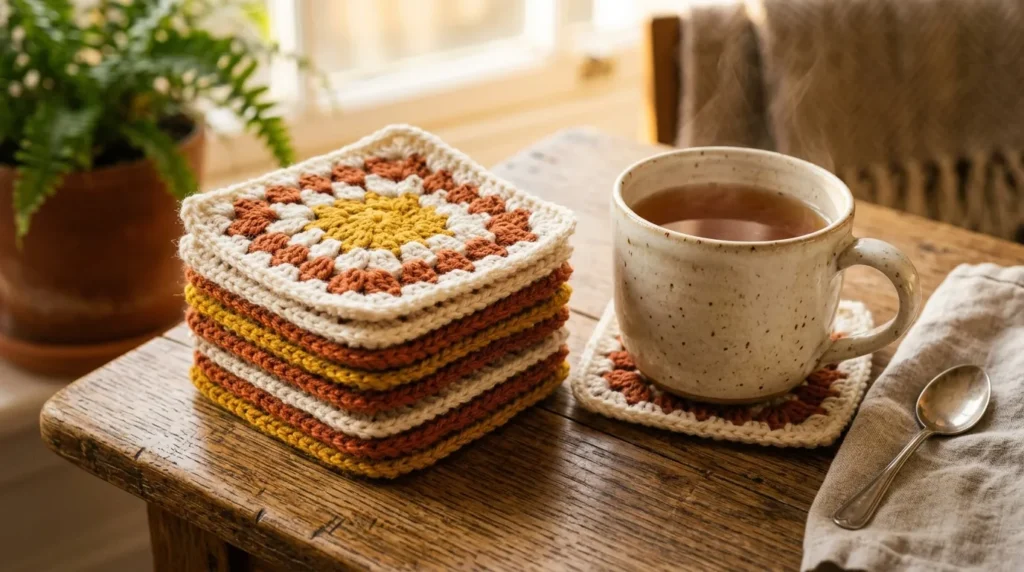
The granny square is one of the most iconic and versatile techniques in crochet, and starting with a small coaster-sized version is a low-commitment way to learn it before attempting a larger blanket or bag built from the same technique. I’ve noticed that once beginners get comfortable with the granny square’s basic repeating pattern, an entire category of future projects — bags, blankets, garments — suddenly feels much more approachable, since so many of them are simply granny squares assembled together in different ways.
How To Get Started
Using worsted weight yarn in two or three colors and a 5.0mm hook, work a small magic ring to start, then build out the classic granny square pattern of grouped double crochet stitches with chain spaces in each corner. Change colors between rounds if desired, weaving in ends as you go rather than leaving them all until the end. A finished coaster typically takes just two to three rounds, making this an ideal project for practicing color changes without the larger time commitment of a full blanket. This idea works especially well as a first project for anyone who eventually wants to make a full granny square blanket.
5. Half Double Crochet Beanie
Quick Benefits
- Wearable, practical finished project
- Introduces basic shaping and increases
- Works up relatively quickly
- Great gift-giving project
- Builds confidence working in the round
Why It Works
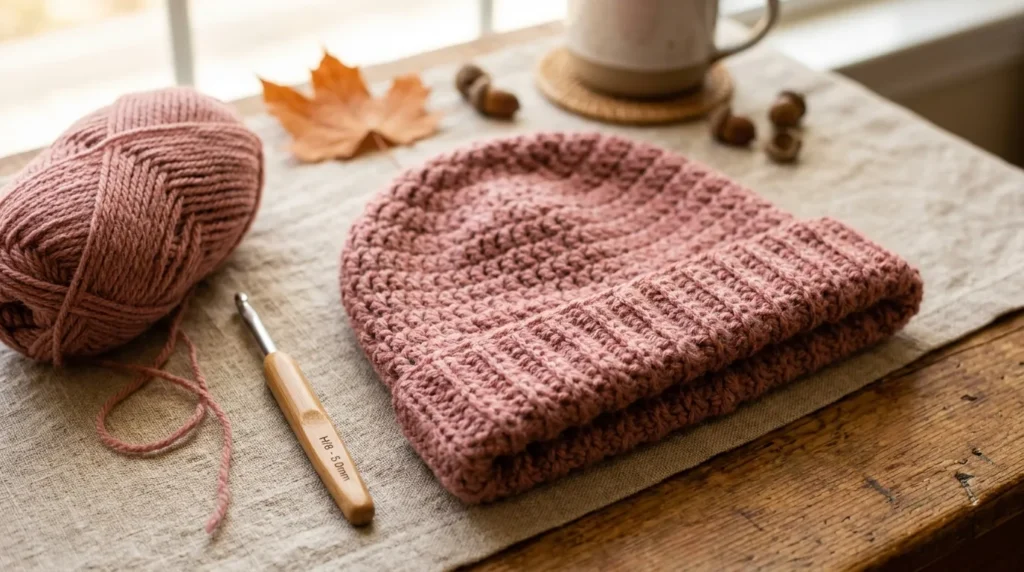
A simple beanie made with half double crochet stitches introduces two new skills at once — working in the round and basic increasing for shaping — while still relying on a stitch that’s comfortable and familiar by this point. That’s why many experienced crocheters recommend a beanie as a natural next step after a scarf, since it takes the same stitch already practiced and applies it to a slightly more structured, three-dimensional shape. A finished beanie also has the advantage of being immediately wearable, which tends to be highly motivating for a beginner.
How To Get Started
Start with a magic ring and work an increasing round of half double crochet stitches until the flat circle reaches the desired head circumference, typically around 20–22 inches for an adult. Once the crown reaches the right diameter, stop increasing and work even rounds without additional stitches until the beanie reaches the desired height, usually 7–8 inches from crown to brim. One simple trick I always suggest is using a stitch marker to mark the beginning of each round, since it’s easy to lose track of where a round starts and ends once working continuously in a spiral.
6. Amigurumi Starter Plushie
Quick Benefits
- Introduces working in the round with single crochet
- Small, quick to complete
- Highly giftable and personal
- Builds confidence with shaping and stuffing
- Endless variation once basics are learned
Why It Works
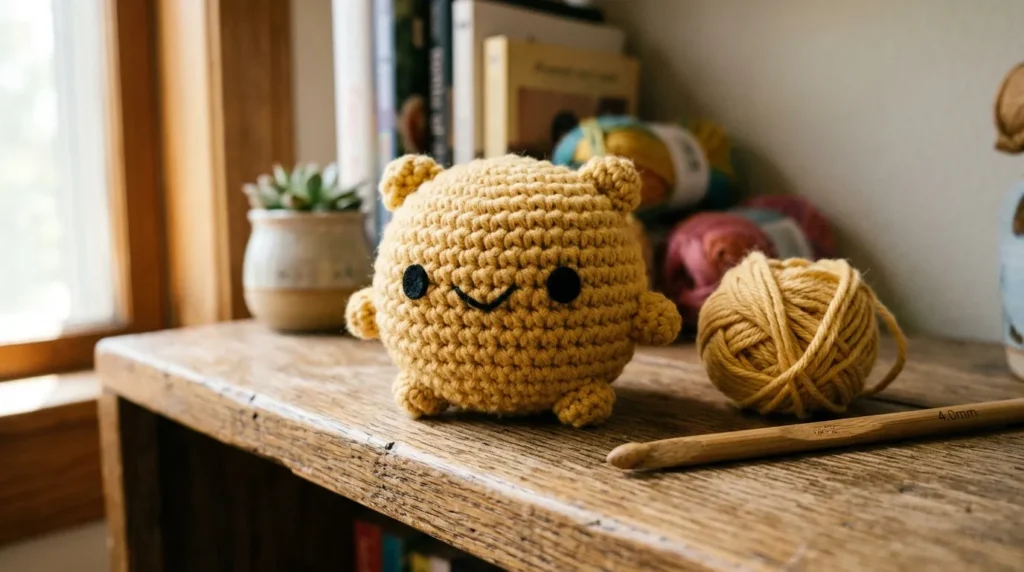
Amigurumi — small stuffed crochet toys — has become one of the most popular categories in crochet, and a simple starter shape like a round ball or basic animal is a genuinely approachable first project despite how intricate finished amigurumi pieces often look. In my experience, the technique itself is more repetitive than it appears from the outside; most amigurumi is built from single crochet worked in a continuous spiral, with occasional increases and decreases to shape the form. I’ve seen this project spark a long-term interest in crochet for beginners specifically because the finished result feels so personal and giftable.
How To Get Started
Using worsted weight yarn and a hook one size smaller than usual (this creates a tighter fabric that keeps stuffing from showing through), start with a magic ring and work single crochet in a continuous spiral, increasing evenly in the first few rounds to shape a basic sphere. Stuff the shape as you near the end, then decrease evenly in the final rounds to close it up. Simple felt or safety eyes and a bit of embroidery for a mouth finish off a basic starter shape into something recognizably charming. This project works especially well as an introduction before attempting a more detailed amigurumi pattern with limbs and separate pieces.
7. Simple Market Tote Bag
Quick Benefits
- Practical, everyday-use finished project
- Reinforces consistent tension over a larger piece
- Introduces basic strap and handle construction
- Great for using up leftover cotton yarn
- Sturdy and long-lasting once finished
Why It Works
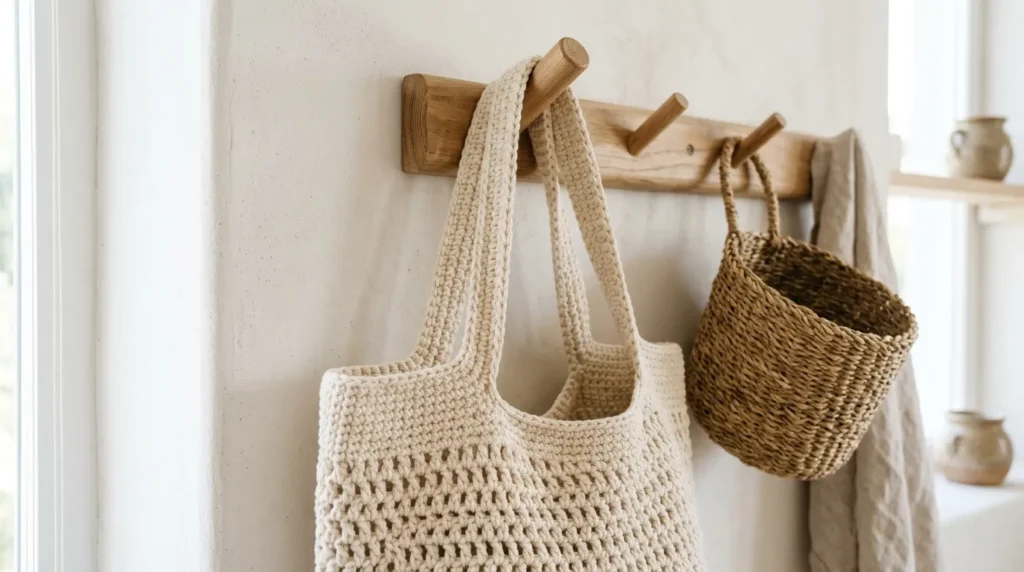
A simple market tote combines everything practiced in earlier projects — consistent single or half double crochet stitches, basic shaping — into a larger, genuinely practical finished object. That’s why many experienced crocheters recommend a tote bag as a good “graduation” project after a few smaller pieces, since it requires enough yardage and row count to reinforce consistency over a longer stretch of work, without introducing any techniques that haven’t already been covered. A finished tote also tends to get used regularly, which makes the time investment feel especially worthwhile.
How To Get Started
Using a sturdy cotton or cotton-blend yarn and a 5.0mm or 5.5mm hook, work a rectangular base, then continue in the round with single or half double crochet to build up the sides of the bag to the desired height. Once the body is complete, crochet two straps separately using a simple chain-and-single-crochet strip, then attach them securely to the top edge of the bag. Cotton yarn is especially well-suited to this project since it holds its shape under weight far better than more elastic acrylic yarns. This idea pairs particularly well with the granny square technique for anyone wanting to add a patterned panel to the bag’s front.
8. Chunky Crochet Blanket
Quick Benefits
- Large, high-impact finished project
- Uses simple, repetitive stitch pattern
- Works up faster than expected with bulky yarn
- Great way to practice consistent tension over time
- Highly satisfying finished result
Why It Works
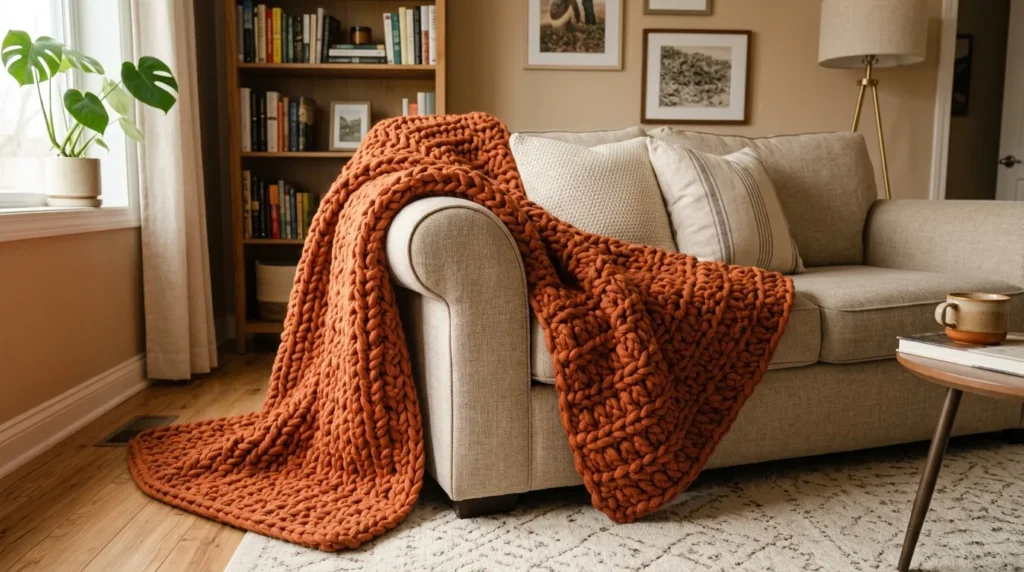
A chunky throw blanket made with thick yarn might look intimidating given its size, but it’s actually one of the more forgiving large projects for a beginner, since it typically relies on the same simple stitch repeated across hundreds of rows rather than requiring complex shaping. I’ve seen this project become a genuine confidence milestone for beginners, since finishing something blanket-sized feels like a much bigger accomplishment than a scarf or coaster, even though the underlying stitch work is often just as simple. The bulky yarn also means the blanket builds up noticeably fast compared to a project made with thinner yarn.
How To Get Started
Using super bulky yarn and a 9.0mm or larger hook, chain enough stitches to reach your desired blanket width, then work half double crochet or double crochet back and forth in rows until the blanket reaches the desired length. Because this project takes considerably more yarn and time than the smaller projects on this list, it’s worth working on it consistently in short sessions rather than in one sitting, to avoid strain on the hands and wrists. A mistake many beginners make on a large project like this is not checking tension periodically throughout — take a moment every so often to make sure the edges are staying straight and consistent rather than only discovering an issue near the very end.
9. Crochet Headband
Quick Benefits
- Quick, low-commitment accessory project
- Great for practicing clean, finished edges
- Uses minimal yarn
- Wearable and easy to gift
- Good practice for buttons or seaming
Why It Works
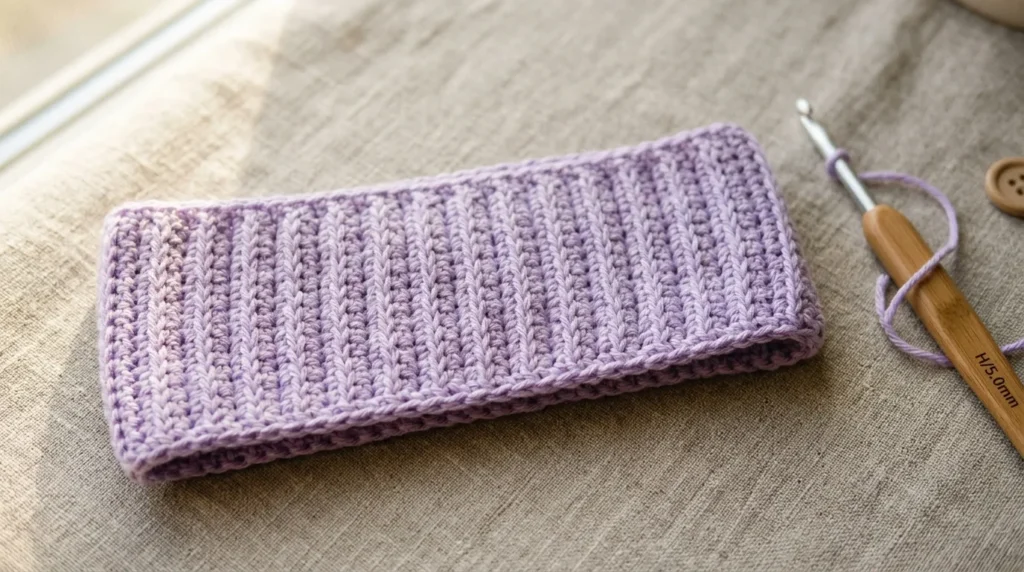
A simple crochet headband is a quick project that introduces the skill of finishing clean, tidy edges and, depending on the style, basic seaming or a button closure — both useful skills for future, more complex projects. One thing that works especially well about a headband as a project is the low time commitment paired with a genuinely wearable result, which makes it an easy way to practice a new small skill without a large project riding on getting it exactly right. I’ve noticed headbands are also a popular quick gift project once a beginner has a few finished pieces under their belt.
How To Get Started
Using worsted weight yarn and a 5.0mm hook, crochet a rectangular strip using half double crochet, sized to wrap comfortably around the head with a slight overlap. Depending on the style, either seam the two ends together directly for a stretchy pull-on headband, or add a button and buttonhole for an adjustable closure. This is a good project specifically for practicing consistent width throughout a strip, since any variation in stitch count becomes immediately visible once the piece is worn. It also pairs well as a companion project to the beanie above, using the same stitch and yarn weight for a matching set.
10. Basic Baby Blanket
Quick Benefits
- Meaningful, giftable finished project
- Builds sustained consistency over many rows
- Small enough to be manageable for beginners
- Uses soft, beginner-friendly yarn
- Great milestone project after smaller pieces
Why It Works
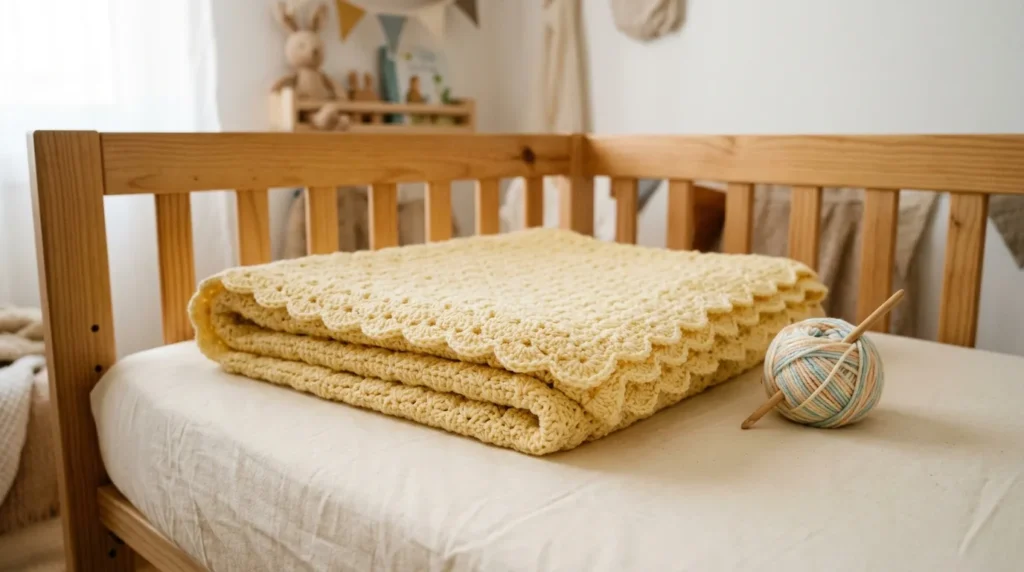
A basic baby blanket takes everything learned from the dish cloth and chunky scarf and applies it to a slightly larger, more meaningful finished project without introducing any new stitches. In my experience, this tends to be one of the most emotionally rewarding beginner projects, since it’s almost always made for someone specific — a new baby in the family or a friend’s shower gift — which keeps motivation high even through the repetitive middle rows that can otherwise feel tedious on a large project. Because a baby blanket is smaller than a full adult throw, it’s also a genuinely achievable size for someone still building consistency and stamina.
How To Get Started
Using a soft, machine-washable worsted weight yarn and a 5.0mm hook, chain enough stitches to reach roughly 30 inches in width, then work single or half double crochet back and forth in rows until the blanket reaches about 36 inches in length. Soft, hypoallergenic yarn labeled as baby-safe is worth seeking out specifically for this project, both for the comfort of the eventual recipient and for easier machine washing. A simple border of single crochet worked around all four edges once the main piece is finished gives the blanket a clean, polished edge and helps it hold its shape over repeated washing.
Frequently Asked Questions
What crochet stitch should beginners learn first? Single crochet is almost universally recommended as the first stitch to learn, since it’s the simplest to execute consistently and forms the foundation for understanding tension and stitch structure. Half double crochet is a natural second stitch once single crochet feels comfortable.
What size crochet hook is best for beginners? A 5.0mm (H) hook paired with worsted weight yarn is one of the most beginner-friendly combinations, since the stitches are large enough to see and work with clearly. Larger hooks and bulkier yarn can also be easier for some beginners, since mistakes are more visible and easier to correct.
What yarn is easiest to crochet with as a beginner? Smooth, light-colored worsted weight yarn is generally easiest for beginners, since it’s simple to see individual stitches and doesn’t split as easily as fuzzy or textured yarns. Cotton and acrylic blends are both widely available and affordable options for practice projects.
How long does it take to learn to crochet? Most beginners feel comfortable with basic stitches after a few practice sessions, though building consistent tension and comfortable speed typically takes several completed small projects. Everyone progresses at a different pace, and finishing several small projects tends to build skill faster than one large, ambitious one.
What’s the easiest first crochet project to make? A basic practice swatch or single crochet dish cloth are generally considered the easiest true starting projects, since both rely on one stitch and a simple, forgiving shape. These projects also double as useful practice before moving on to something larger.
Can I learn to crochet without a pattern? Yes, many of the simplest beginner projects, like a scarf or dish cloth, don’t require reading a formal pattern at all — just a stitch count and a repeated row. Learning to read basic patterns becomes more useful once you move on to shaped projects like hats or amigurumi.
Why does my crochet look uneven? Uneven crochet is almost always related to inconsistent tension, meaning the yarn is being pulled tighter or looser from stitch to stitch or row to row. This typically improves naturally with practice, and working a few basic swatches before starting a real project can help build more consistent muscle memory.
Final Thoughts
Crochet is one of those skills that rewards patience far more than natural talent — nearly every beginner starts with uneven, slightly wobbly stitches, and nearly every experienced crocheter has a drawer full of early practice pieces to prove it. The projects that actually stick tend to be the ones that stay simple enough to finish, rather than the most ambitious pattern in your Pinterest saves.
Start with one or two ideas and gradually build up to more complex projects as your stitches even out and your confidence grows. A finished dish cloth or a lopsided first coaster might not look like much, but it’s very often the project that turns “I tried crochet once” into a genuine, lasting hobby.
Related Articles
- Easy Crochet Blanket Patterns for Beginners
- How to Read a Crochet Pattern
- Best Yarn for Amigurumi Projects
- Crochet Gift Ideas for Every Occasion
- DIY Home Decor Crochet Projects